
Ectoin: The cellular shield for the skin in the modern exposome
In a world where our skin is exposed daily to environmental stressors such as UV radiation, ozone, and particulate matter, it is continuously challenged. These factors generate oxidative stress in the cells—a gradual process that places lasting strain on skin structures.

In a world where our skin is exposed daily to environmental stressors such as UV radiation, ozone, and fine particulate matter, it is continuously challenged. These factors generate oxidative stress in the cells—a gradual process that places a lasting strain on skin structures.
Under these conditions, simply providing moisture reaches its limits. Modern skin research shows that environmentally stressed skin requires intelligent, multifunctional active ingredients that go far beyond short-term hydration and act as a biochemical shield at the cellular level.
One outstanding example from biotechnological and dermatological research is ectoine. What originated in nature as a fascinating survival mechanism of microorganisms in extreme habitats—such as barren deserts or hypersaline lakes—has established itself in clinical studies as a highly effective cell protectant for human skin.

What are osmolytes and how do they work?
To understand why ectoine is so exceptional, it is worth taking a look at its class of active ingredients: so-called osmolytes.
In nature, extremophilic organisms use these small molecules as a natural shield against extreme dryness, UV radiation, and temperature fluctuations. For the human body, this means: due to its special molecular structure, ectoine binds water molecules so tightly to itself that a dense, stable hydration shell is formed around cellular proteins and membranes.
This fine hydration shell stabilizes cell membranes, proteins, and enzymes without blocking or altering their natural biological function. Even under severe stress, the cells remain intact, protected, and fully functional.
Scientific evidence: Cell protection against oxidative damage and ROS
Numerous laboratory and clinical studies demonstrate ectoine's protective mechanisms at the cellular level:
- Protection against the effects of ROS: Ectoine has been proven to protect cellular structures from the destructive effects of reactive oxygen species (ROS) and oxidative stress by stabilizing the integrity of proteins and cell membranes before oxidative processes can damage them.
- Support for the body's own defenses: Studies also show that ectoine specifically supports the activity of important antioxidant protective enzymes—such as superoxide dismutase (SOD)—and reduces lipid-peroxidizing degradation products. This noticeably relieves the skin's own antioxidant defense system.
- Defense against photoinduced damage: Ectoine also has been proven to preserve cellular structures from stress-related damage caused by UV radiation, thereby preventing light-induced skin aging.
Strengthening the barrier and reducing water loss
In addition to cellular protection, ectoine plays a central role in the physical integrity of the skin barrier. Clinical studies on humans show that ectoine effectively regulates and reduces transepidermal water loss (TEWL).
Because the dense hydration shell firmly anchors moisture in the upper layers of the skin, the skin loses measurably less water to the environment in everyday life.
The result: fine lines caused by dryness are softened, the skin surface becomes smoother, and the natural barrier function is stabilized, so that irritants and allergens cannot penetrate as easily.

Integration into the MUTI philosophy
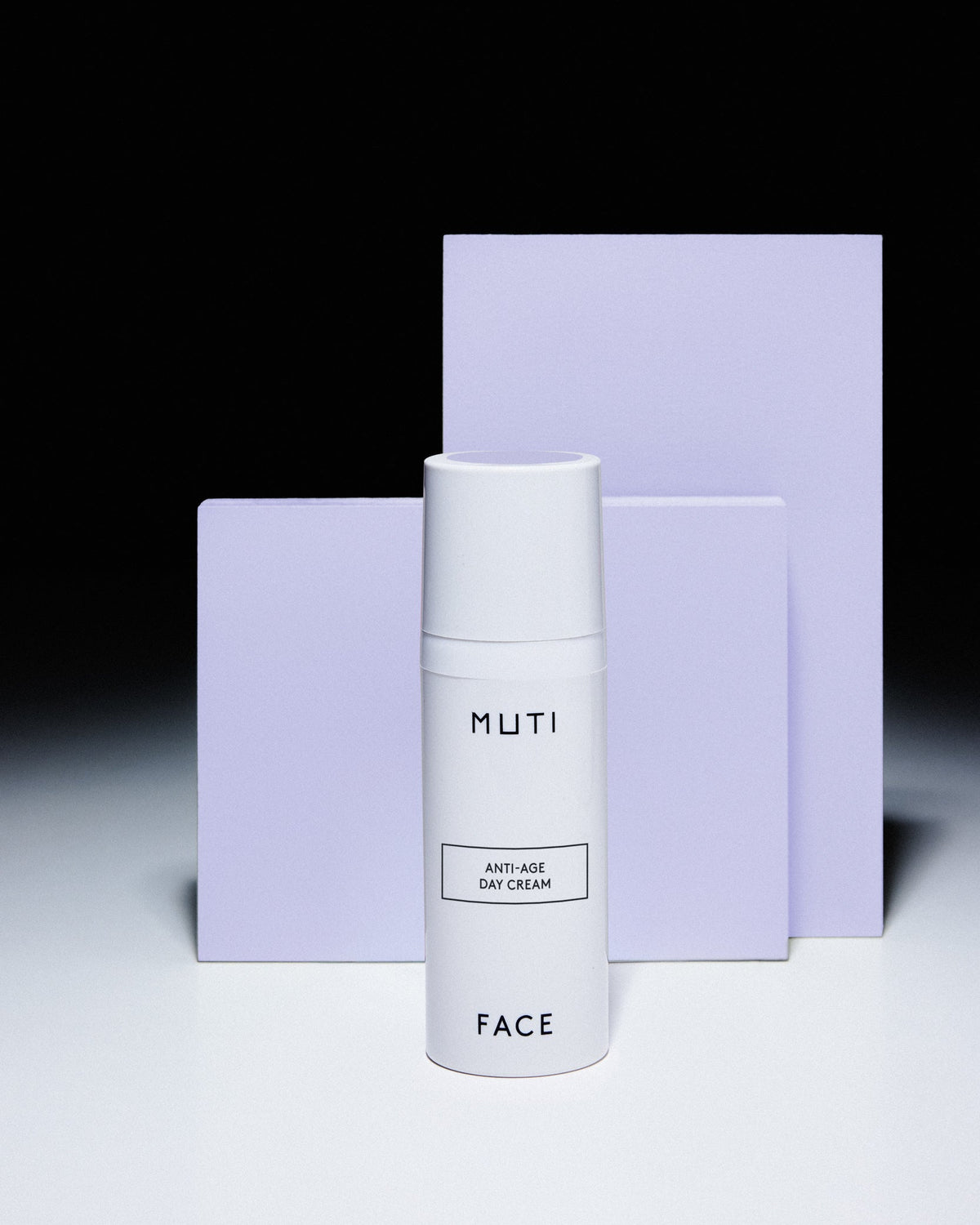
At MUTI, ectoine is specifically used as an essential building block in highly effective formulations—such as the Anti Age Day Cream, the Anti Age Night Cream, or the Calm Down Serum.
Since ectoine fends off cellular stress and protects the barrier, it perfectly complements the brand's philosophy—minimalism: instead of overloading the skin with an overwhelming abundance of isolated individual substances, a multifunctional, scientifically sound active ingredient like ectoine provides exactly the biochemical protection that the skin needs in the modern exposome to preserve its youthful vitality and balance on its own.
Scientific references
Bownik, A., & Stepniewska, Z. (2016), Ectoine: Properties, applications, and potential mechanisms of action against stress, Journal of Applied Microbiology, 121(4), 931–941
Chen, Y., et al. (2022), Ectoine protects human skin fibroblasts against oxidative stress and apoptosis induced by UVA and H2O2, Oxidative Medicine and Cellular Longevity, 2022, 4562189
Graf, R., et al. (2008), The multifunctional role of ectoine as a natural cell protectant, Skin Pharmacology and Physiology, 21(2), 57–67
Heinrich, U., et al. (2007), Ectoine: A natural cell protectant and its impact on skin barrier function and hydration in vivo, Skin Pharmacology and Physiology, 20(3), 138–145